

Half the council's £500,000 reorganisation reserve now pays for legal costs. Its own analysis puts the cost of being merged into West Essex at £4m.
Harlow Council has committed £250,000 to a court challenge against the government’s plan to abolish it, half of the £500,000 it set aside in this year’s budget to pay for reorganisation itself. The West Essex merger would fold Harlow, Epping Forest and Uttlesford into a single council on 1 April 2028.
Update, 12 September 2026: the government withdrew the West Essex decision on 7 September 2026, and Essex County Council’s leader says it did so because of this judicial review. Harlow Council is no longer being abolished. See Harlow Council not abolished: West Essex merger withdrawn. The article below records the position as it stood in August 2026.
The commitment is recorded in a decision signed by the Leader of the Council on 24 July and published the same day. It authorises the council to take an active part, as an “interested party”, in judicial review proceedings brought by Essex County Council. That claim is against the Ministry of Housing, Communities and Local Government, over its decision to replace Essex’s 15 councils with five.
None of that appeared in the council’s statement on Tuesday, which published five letters from Councillor Dan Swords to ministers and said only that the council “alongside other councils, is already taking legal action”. The decision record carries the figures.
What the council is arguing
Essex County Council’s claim seeks to quash the government’s decision of 25 March. Harlow is supporting it on its own separate grounds, set out in the decision report:
- the ministry knew, and knows, about the immediate costs that will fall on Harlow before the new council starts work
- Harlow cannot meet those costs without damaging its finances and its Building Harlow’s Future regeneration programme
- it would therefore be irrational to press ahead without funding them, so the government should meet the costs in full, abandon the plan for West Essex, or defer it
The report is blunt about why the council decided to join in rather than watch. Essex County Council’s own grounds are broad, it says, but “none of them deal with the affordability of the immediate implementation costs”, so if Harlow stayed out, that argument would not be heard.
The numbers behind the row
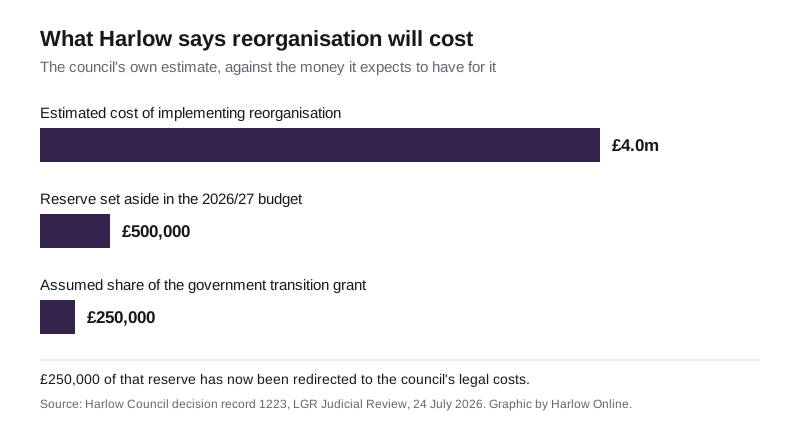
The council’s finance officers put the likely transition cost at about £4 million, and warn that figure could prove low because delays to regeneration are easy to underestimate. Diverting staff from the regeneration programme could cost a further £2 million or more in lost tax receipts and commercial income over two years.
Against that, the money available is small. The council put £500,000 into a reorganisation reserve when it set the 2026/27 budget, knowing it “was never going to be enough”. The government’s decision letter of 25 March confirmed £63m of transition funding nationally and “at least £900,000 per each new unitary authority”, which works out at £4.5m for the five new Essex councils. Harlow assumes that its West Essex allocation will be split between four authorities and that its share will be £250,000.
Fighting the case has its own price. The report estimates legal costs of less than £50,000 to £100,000 if the claim is refused permission at the first stage. If it clears that hurdle and then fails at a full hearing, the figure rises to between £100,000 and £250,000. The council judges the spending “prudent and proportionate”, because the alternative is an unfunded reorganisation that stops the building programme residents voted for in May.
In his letters to ministers the Leader puts the government’s offer at “just £1 million for each new unitary authority”. The council’s own report is more careful: it records the confirmed figure as £900,000, and says an increase to £1m has been announced but “is as yet unconfirmed formally”.
How Harlow got here
The council also supported the winning proposal. The government’s decision letter lists Harlow Council among the ten councils that put forward the five-unitary model. Its own report says it did so “on a least-worst case basis”, judging it the most coherent of the four submitted.
- 16 December 2024: the English Devolution White Paper sets out the end of two-tier local government
- 5 February 2025: the government invites Essex councils to draw up proposals
- 26 September 2025: four rival proposals are submitted
- 25 March 2026: ministers choose the five-council model, creating West Essex from Epping Forest, Harlow and Uttlesford
- 18 May 2026: Essex County Council sends the government a pre-action letter
- 8 June 2026: the government rejects its grounds
- 3 July 2026: proceedings are issued and served on Harlow as an interested party
- 24 July 2026: Harlow decides to take an active part, and to pay for it
West Essex would be a council of about 334,000 people, on the latest population estimates for mid-2025: Epping Forest 138,394, Harlow 98,543 and Uttlesford 96,762. Harlow would be under 30% of it, which is the basis of the Leader’s warning that most councillors on the new authority would come from Epping and Uttlesford. Ward boundaries for the new council have not been set. The government’s letter addresses the size point directly, saying the 500,000 population figure “has always been a guiding principle, not a fixed threshold”.
What it means for you
Nothing changes yet. Harlow Council still collects your bins, bills you for council tax and decides your planning applications. At the time of writing it was due to be abolished on 1 April 2028, with elections to the new council in May 2027 replacing any local elections otherwise due that year. Both of those have since gone: the decision was withdrawn on 7 September 2026 and the May 2027 poll will be an ordinary Harlow Council election.
The £250,000 comes from a reserve, not from this year’s council tax, so there is no immediate effect on services. It does mean that if the challenge fails, a quarter of the money the council had put by for the changeover has gone on lawyers.
The step that has to come next is the Structural Changes Order, the piece of legislation that actually abolishes the councils and creates the new ones. It needs parliamentary approval, and it has not yet been made: the Leader’s letter to the Prime Minister on 13 August says so, and no such order for Essex is published on legislation.gov.uk. Until it is laid, the timetable the council calls undeliverable is still only a plan.
It was never laid. The decision behind it was withdrawn on 7 September 2026.
Sources
- Harlow Council decision record 1223, LGR Judicial Review, 24 July 2026 and the decision report
- Secretary of State’s decision letter to Essex leaders, 25 March 2026 and the implementation letter to chief executives
- Harlow Council statement and letters to ministers, 18 August 2026
- ONS mid-2025 population estimates via Nomis
Correction and update, 12 September 2026: this article was published on 19 August 2026 and described a merger that was then still government policy. The government withdrew the West Essex decision on 7 September 2026. The passages stating that Harlow Council would be abolished on 1 April 2028, and that the May 2027 election would elect the new council, have been marked as superseded rather than removed. The current position is in Harlow Council not abolished: West Essex merger withdrawn.
Have your say